
PME ends 2025 in a strong financial position: funding ratio rises to 125.3%

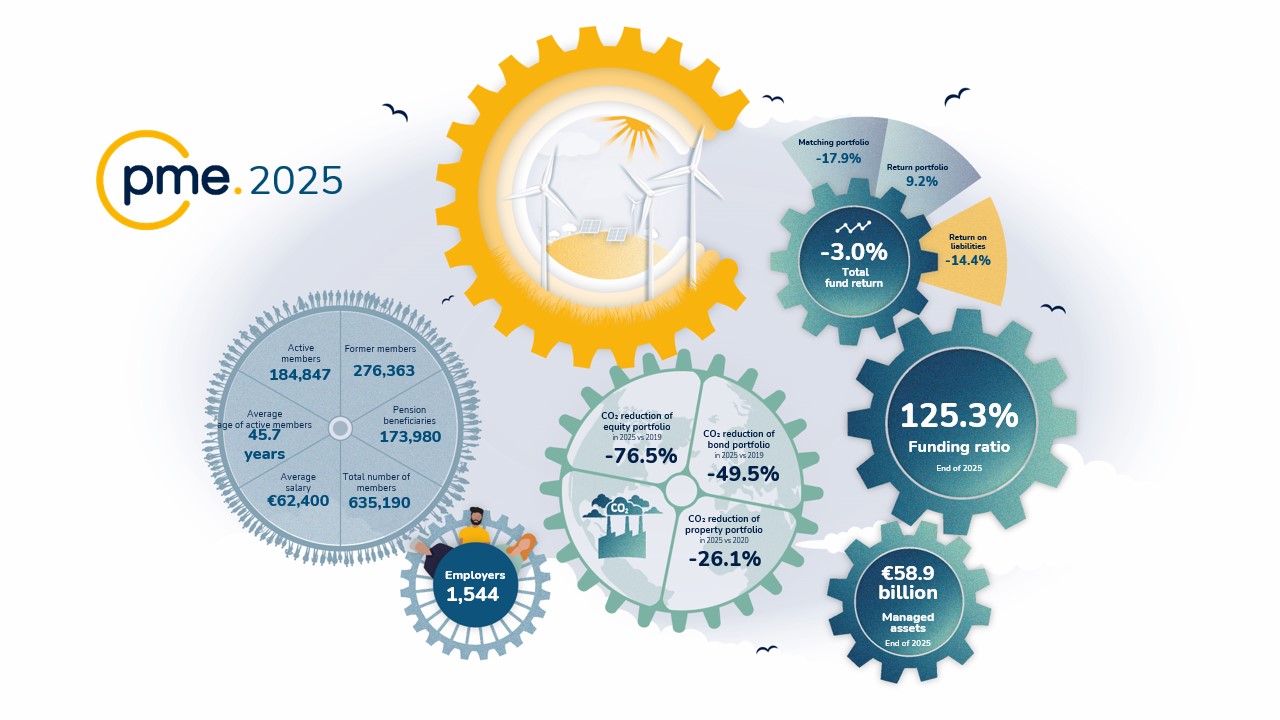
PME Pensioenfonds looks back on a financially solid year. Thanks to higher interest rates and a positive return on the return portfolio, the current funding ratio rose from 113.0% to 125.3% over the past year. This healthy financial position enabled PME to increase pensions by 2.82% as of 1 January 2026. At the same time, the fund took major steps in 2025 to prepare for the new pension scheme scheduled for 1 January 2027.
2025 was a year for PME in which developments followed each other at a rapid pace. Continuing geopolitical turmoil and economic dynamism globally demanded ongoing vigilance regarding strategic choices and the fund’s position.
Alae Laghrich, Chairman of the PME Executive Board: “The wars in Ukraine and the Middle East, in addition to immense human suffering, are creating huge international uncertainty and economic pressure. In this troubled world, it is our job to provide calm and stability. We therefore maintained our long-term course over the past year. Our funding ratio rose to 125.3%, allowing us to increase pensions by 2.82% on 1 January last. Even in times of external crises, members have to be able to trust that their pension is in safe hands with us.”
Investing for a strong pension
Pension money has to be invested. After all, to build a good pension it is not enough simply to save the contributions made. Investment income ultimately makes up approximately two thirds of the pension that our pension beneficiaries receive.
The global economy proved resilient in 2025. This translated into a strong 9.2% return on PME’s return portfolio. On the other hand, the return on the matching portfolio was strongly impacted by rising interest rates; in line with the fall in the value of pension liabilities, this portfolio posted a negative return of almost 18%. As a result, the return on the total investment portfolio worked out at -3.0%.
By diversifying our investments across different asset classes, regions and sectors, we limit the risks associated with investing and ensure sufficient returns over the years. Since 2015, the goal with the investment portfolio has been to achieve on average at least an additional return of 1.5% per annum on top of the change in value of future pension liabilities. This is underpinned by an ALM study. This means that the average return on our investments for the long term must be at least 1.5% per year higher than the ‘return’ on pension liabilities. We have achieved this objective: over the past 15 years, the average return on the portfolio has been 4.85%, compared to 1.84% for liabilities.
ESG and return
PME structurally includes ESG criteria in the investment policy. Screening companies based on ESG criteria is a form of risk management. As far as possible, we seek to avoid a situation where the companies in our portfolio are exposed to, for example, climate risks, legal risks, human rights violations or poor governance. We firmly believe that this will reduce the risks to our investments in the long term and produce an equal or possibly even higher return.
In compiling the investment universe for the equity portfolios, we apply, among other things, screening based on these criteria, for both developed markets and emerging markets. We have been doing this for developed markets since July 2019 and for emerging markets since July 2020. Since then, we have been closely monitoring the effects on the portfolio and on returns.
Our analyses show that, on balance, taking ESG criteria into consideration and applying the exclusion policy over these periods has had a positive effect on the return on the equity portfolios.
For developed markets, our portfolio has generated an average return of 12.0% per annum since July 2019, compared to 12.3% for the MSCI World Index. The application of ESG criteria has made a positive contribution of 0.9% on an annual basis. Portfolio construction management measures, including measures to mitigate concentration risk, have had a negative impact of 1.2% on an annual basis. On balance, the portfolio has thereby underperformed the standard MSCI World Index by 0.3%.
A positive effect of ESG is also visible in emerging markets. Since July 2020, our portfolio has achieved an average return of 7.5% per annum, compared to 7.0% for the MSCI Emerging Markets Index. ESG criteria have contributed positively to this return, with an annualised 1.0%. Portfolio construction management measures, including management measures to mitigate concentration risk, have made a negative contribution of 0.5% on an annual basis. On balance, the portfolio has achieved a return that is 0.5% higher on an annual basis than the standard MSCI Emerging Markets Index.
Both portfolios have had a better ESG profile than the aforementioned benchmark indices, partly due to significantly lower CO₂ emissions and a stronger alignment with the Sustainable Development Goals (SDGs).
For risk management purposes, PME uses a concentration limit for individual positions in the equity portfolios. This limit prevents the portfolio from becoming too dependent on individual companies. This reduces the risk of a sharp fall in the price of one company having a major impact on the total value of the portfolio. As a result, PME is not so invested in large US technology companies that have actually produced high returns over the period measured.
Investing in the Netherlands
We invest close to home when we can. We firmly believe that investing in the Netherlands generates positive social returns. In this way, we contribute to a resilient economic climate and stimulate the Netherlands’ competitiveness. This is a win-win situation, with a positive impact on employment that is good for our members and for employers who are affiliated with us.
PME also strives to help solve the housing shortage in the Netherlands. We do this by focusing on the construction and purchase of affordable rental homes in particular. In the coming years, we have the ambition to grow our property portfolio in the Netherlands to approximately 6% of our total investment portfolio, with affordable rental properties making up a large part of this. In this way, PME aims to have thousands of rental homes built in the mid-range segment over the coming years, preferably using natural bio-based materials as much as possible.
Construction started in 2025 on, among others, De Koffiefabriek in Amsterdam (63 timber-framed homes on the site of a former coffee factory), De Sax in Rotterdam (916 homes, of which 411 rental apartments by PME) and Common Ground in Nieuwegein (43 rental homes, mostly timber-built).
Alongside the housing shortage, PME also sees a clear societal and economic need for security and resilience. We have been investing in defence for years. It is part of our sector. In 2025, PME further expanded this category by investing €40 million in the European defence fund of Keen Venture Partners.
The table below shows our investments in the Netherlands. At the end of 2025, approximately 15.7% of our investment portfolio was invested in the Netherlands. This consolidates a rising trend that started in 2023, when 14.6% of assets were invested in the Netherlands. The capital invested in the Netherlands rose from €7.9 billion in 2023 to €9.3 billion in 2025.
Investments in the Netherlands by asset class | Amounts (x EUR 1 million)
2025 | As a percentage of total assets invested
2025 | Amounts (x EUR 1 million)
2024 | As a percentage of total assets invested
2024 |
Government bonds | 1,895 | 3.2% | 1,763 | 3.0% |
Corporate bonds | 1,606 | 2.7% | 1,530 | 2.6% |
Mortgages | 2,951 | 5.0% | 2,751 | 4.6% |
Equities | 190 | 0.3% | 172 | 0.1% |
Property | 2,261 | 3.8% | 1,971 | 3.3% |
Other | 360 | 0.6% | 792 | 1.4% |
Total for the Netherlands | 9,262 | 15.7% | 8,980 | 15.1% |
* The amounts have been rounded.
Carbon footprint of the investment portfolio
The carbon footprint of our equity and corporate bond portfolios was reduced by 76.5% and 49.5% respectively by the end of 2025 compared to 2019. The carbon footprint of our property portfolio was reduced by 26.1% in 2025 compared to 2020, and our target for 2030 -/- 40%.
Trajectory to 2027: transition to the new pension system
In 2025, we worked hard behind the scenes to reinforce the foundations for the transition to the new pension scheme on 1 January 2027. The necessary preparations and the development of fallback scenarios caused a temporary increase in costs to €178 per member in 2025. The first funds have now been successfully transferred to pension provider TKP. Based on these results, PME has concluded that the planned transition date is feasible and the risks are manageable; the need to invoke fallback scenarios has therefore decreased sharply.
Outlook for 2026
Looking ahead to the current year, Alae Laghrich, Chairman of the Executive Board, wishes to emphasise the importance of careful communication: “We started 2026 with a healthy funding ratio of around 125%. It is a strong starting point in a tumultuous world, though we are reserving judgement at this stage: the year still has a long way to go and developments are following each other in rapid succession. This year is all about preparing for the new scheme in 2027. Last year, we reached thousands of members through in-person meetings in theatres across the country and in the workplace. We also informed our supporters through webinars, newsletters and the PME Magazine. In 2026, we are shifting up a gear. This autumn, we will make the switch personally: we will then communicate the provisional individual amounts and everyone will be given a concrete idea of what the new scheme means for them. Together with partners such as TKP and MN, we will realise this transition with confidence.”
Read our annual report: www.pmepensioen.nl/en/annual-reports